Amplify Platform’s Integration Fabric: Connect enterprise systems securely
✓ Connect applications, APIs, data, events, files, and workflows across cloud and on-premises environments
✓ Automate business processes with reusable, governed integration flows
✓ Turn digital initiatives and AI outputs into controlled business action


Standardize how teams connect systems and automate processes to accelerate delivery, reduce complexity, and improve operational control.
Up to 40%
improved delivery time
30%
reduction in fragmentation-related operating costs
One
monitoring experience across every flow step
80+
application connectors plus protocol connectors
Connect, govern, and engage on one platform.
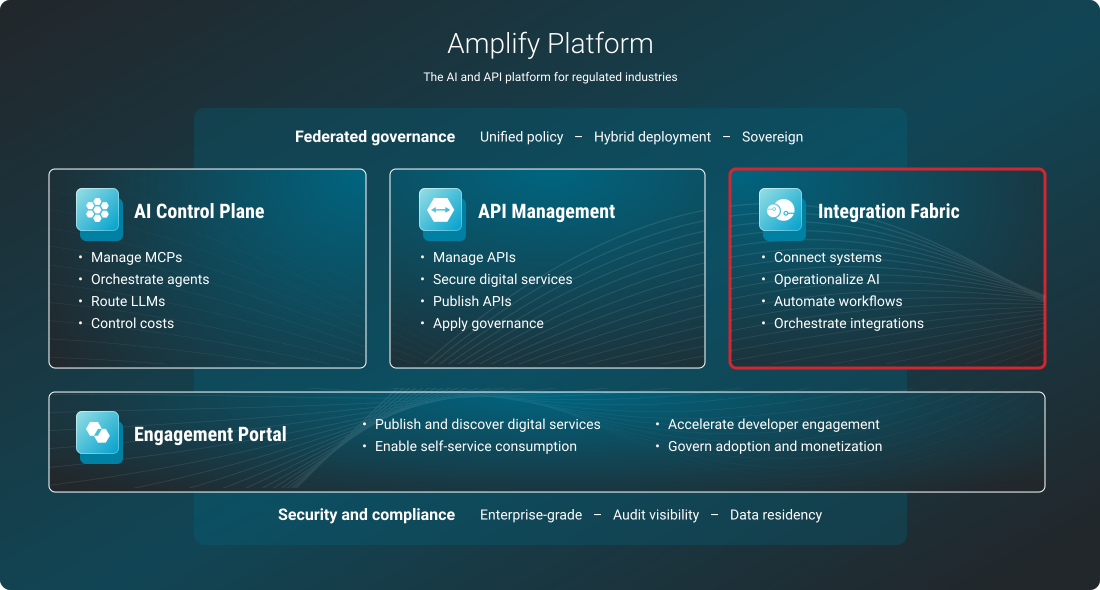
Integration Fabric connects apps, APIs, data, events, files, and workflows. Together with API Management, AI Control Plane, and Engagement Portal, it delivers one governed platform across hybrid environments.

Connect enterprise systems, data, and events
- Connect applications, APIs, data, events, files, and workflows across the enterprise
- Support APIs, events, files, and application integration patterns
- Extend existing Managed File Transfer, B2B integration, and EDI processes through governed connections
- Keep mission-critical systems in place as new digital and AI-enabled processes are introduced

Automate enterprise workflows end to end
- Orchestrate applications, data, events, AI services, and human tasks in one flow
- Replace manual handoffs with governed automation
- Use visual orchestration to accelerate delivery
- Support AI agent orchestration by connecting agents and Model Context Protocol (MCP) services to approved enterprise systems and workflows.

Orchestrate hybrid integration
- Run integrations across cloud and on-premises environments
- Connect legacy, packaged, and modern applications
- Preserve sovereignty and customer-controlled deployment
- Modernize without forcing rip-and-replace

Operationalize business processes across enterprise systems
- Embed digital and AI-enabled capabilities into production business processes
- Provide governed access to enterprise systems through reusable integration flows
- Build reusable integration patterns for AI-enabled and non-AI workflows
- Improve resilience and visibility across every handoff
Connect the systems, data, and workflows that turn digital and AI initiatives into action.
Operationalize digital processes
Connect applications, data, workflows, and AI initiatives to the systems required to produce real business outcomes.
Connect critical enterprise systems
Bring applications, APIs, events, files, and data into one integration fabric without rebuilding what already works.
Automate end-to-end workflows
Replace manual handoffs with governed flows that coordinate applications, data, events, and people.
Build hybrid by design
Run integrations across cloud and on-premises environments while meeting resilience, sovereignty, and control requirements.
Modernize without replacement
Introduce new digital and AI-enabled processes while preserving legacy systems, packaged applications, and existing investments.
Scale reuse across teams
Create reusable flows, connectors, and patterns that reduce duplicate work across business units and initiatives.
Expose systems through governed flows
Provide controlled integration paths to enterprise systems instead of unmanaged point-to-point connections.
Turn decisions into process action
Trigger repeatable workflows from AI, application, or event-driven inputs with visibility across every handoff.
Built for complex, connected industries
Bring applications, data, events, files, and workflows together across the environments where each industry operates.

Connect real-time payment operations
Orchestrate payment events, fraud services, core banking systems, and exception workflows with visibility across every handoff.

Accelerate clinical data exchange
Move health data, files, events, and API transactions reliably among providers, payers, laboratories, and partners.

Deliver connected citizen services
Link portals, identity services, case systems, payments, documents, and notifications across agencies and jurisdictions.

Build a resilient, intelligent supply chain
Use AI to anticipate disruptions, automate decisions, and improve performance across suppliers, production, inventory, and logistics operations.
Integration Fabric FAQ
What is Integration fabric?
Integration Fabric is used to integrate applications, data, APIs, and AI systems into unified workflows across hybrid environments.
How does Integration Fabric support AI agents and MCP servers?
Integration Fabric supports AI agents by connecting them to the applications, APIs, data, events, and workflows they need to take business action. It can expose governed capabilities through Model Context Protocol (MCP), orchestrate agent-driven workflows, and coordinate AI services with enterprise systems and human tasks across hybrid environments.
Which deployment options does Integration Fabric support?
Integration Fabric supports Public SaaS, Private SaaS, and sovereign on-premises deployment models. Organizations can combine these options across one integration landscape and run workloads where business, security, data-residency, and regulatory requirements demand. This flexibility enables true hybrid integration patterns while maintaining centralized governance, visibility, and operational control across cloud and customer-managed environments.
Which security certifications and data-residency options are supported?
Integration Fabric is supported by Axway’s enterprise security and compliance program. Axway Cloud Services are ISO/IEC 27001:2022 certified and undergo annual SOC 2 Type II audits. Axway also maintains SOC 3 and ISO 9001 certifications. Applicable certifications and compliance coverage depend on the selected service and deployment model. For data residency, cloud deployments can keep customer data at rest within the hosting region specified in the subscription agreement. Integration Fabric also supports customer-managed and sovereign on-premises deployment patterns, allowing sensitive processing to remain within approved infrastructure, geographic boundaries, and jurisdictions. Specific regions, certifications, and controls should be confirmed for the customer’s chosen configuration.
How is Integration Fabric licensed?
Integration Fabric is licensed by transaction volume, giving organizations the flexibility to deploy it wherever their business, technical, and regulatory requirements demand. Because licensing is not based on the number of deployed instances, teams can distribute workloads across Public SaaS, Private SaaS, and on-premises environments without adding instance-based licensing complexity. This approach keeps the focus on the transactions processed while supporting scalable hybrid and sovereign deployment patterns.
Connect everything without complexity
See how Integration Fabric helps you connect applications, data, events, and AI services across your enterprise with speed, visibility, and control.


